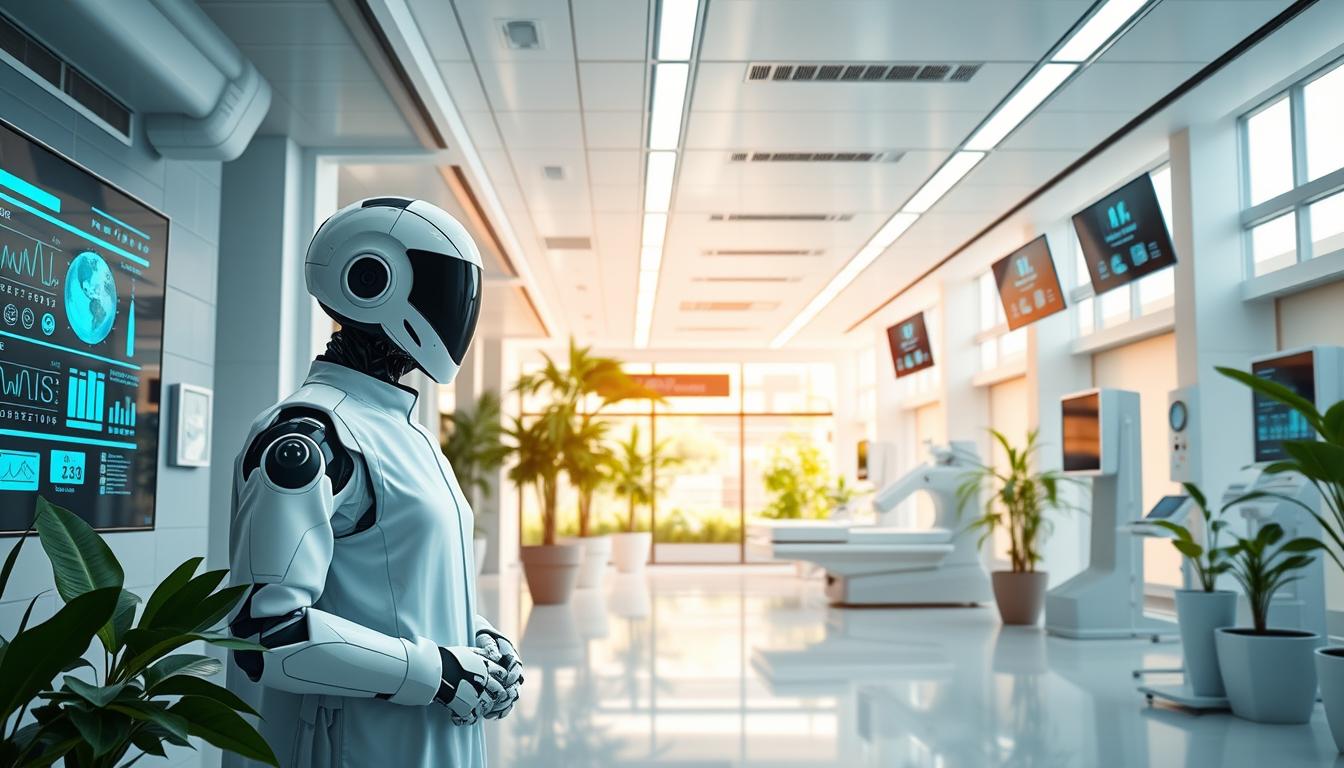
Artificial Intelligence (AI) is changing healthcare in big ways. It’s making patient care, medical discoveries, and digital health better. AI uses machine learning and data analysis to improve diagnosis, tailor treatments, and make healthcare more efficient. AI in Modern Healthcare means better and faster medical help. It can look at medical images like X-rays and MRIs as well as doctors. This leads to finding diseases sooner and treating them more effectively.
AI also helps by looking at lots of patient data. It finds trends, predicts health outcomes, and makes treatments more personal. With AI, doctors can keep an eye on patients’ health in real-time. This helps catch and fix health problems quickly.
Key Takeaways
- AI enhances diagnostic accuracy and enables earlier detection of diseases through advanced medical imaging analysis
- AI-driven analytics unlock insights from vast patient data to personalize treatment plans and improve health outcomes
- AI-powered remote monitoring and telemedicine solutions expand access to healthcare, particularly in underserved areas
- Automation of administrative tasks through AI reduces the burden on healthcare staff and minimizes errors
- AI accelerates the drug discovery and development process, leading to more efficient and effective treatments
Understanding AI’s Impact on Modern Healthcare
Artificial intelligence (AI) has changed healthcare a lot. It helps doctors make better diagnoses and makes tasks easier. It also makes care more personal. AI has come a long way since the 1960s and is now key in healthcare.
Defining AI in Healthcare Settings
AI in healthcare means computers that can do things humans do, like diagnosing and writing medical notes. It uses many techniques, like machine learning and natural language processing. These help in many ways.
Current Applications and Technologies
AI is changing healthcare a lot. It can quickly look at heart images and spot problems. It also helps doctors find and treat colon and pancreas issues better.
The Evolution of Healthcare AI
AI in healthcare started in the 1950s. The Dartmouth AI Conference in 1956 was a big step. Since then, we’ve seen robots and systems like IBM’s Watson. Now, AI is set to change healthcare even more.
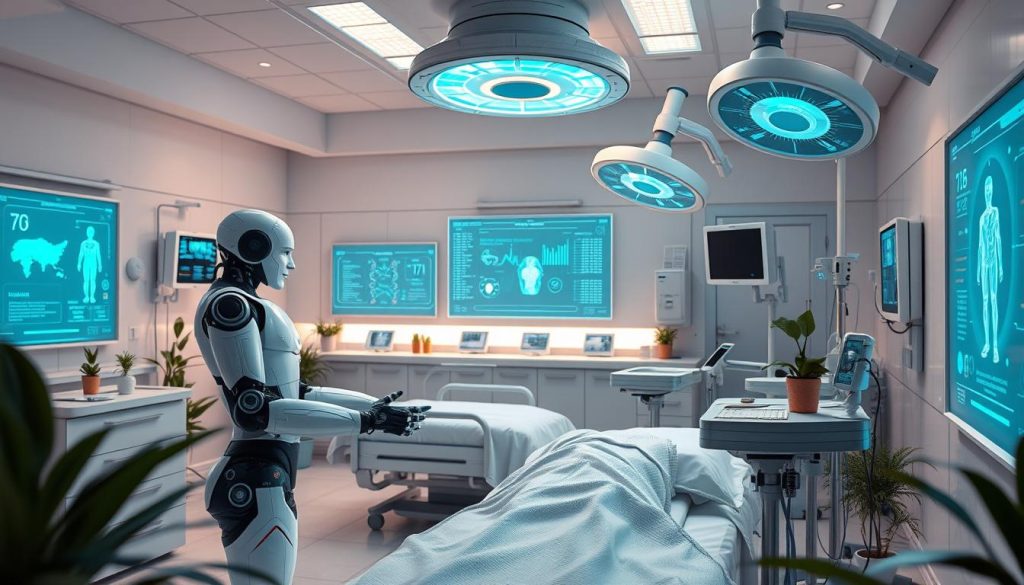
AI is making healthcare better. It helps doctors and makes care more personal. As AI gets better, we’ll see even more changes in how medicine is done.
Enhancing Diagnostic Accuracy Through AI
Artificial intelligence (AI) is changing healthcare. It’s making doctors better at finding problems in medical images. AI can look at X-rays, MRIs, and CT scans like no human can.
AI uses special algorithms to spot things humans might miss. It can look at lots of data quickly and accurately. This means doctors can find diseases like cancer sooner.
A study by the American Medical Informatics Association showed AI helps doctors. Doctors using AI tools like ChatGPT did better than those without. They also worked faster, saving time.
AI does more than just look at images. It can guess if someone might get sick or have complications. This helps doctors act fast, making patients better and saving the healthcare system.
As AI becomes more common in healthcare, the future looks bright. More research and better data will make AI tools even better. This will change how we get medical care all over the world.
| Metric | Physicians Without AI | Physicians With AI |
|---|---|---|
| Median Diagnostic Score | 74 | 76 |
| Average Time for Case Assessment | More than a minute longer | Faster by more than a minute |
| Prior Use of AI in Clinical Assessment | Less than a third | About a third |
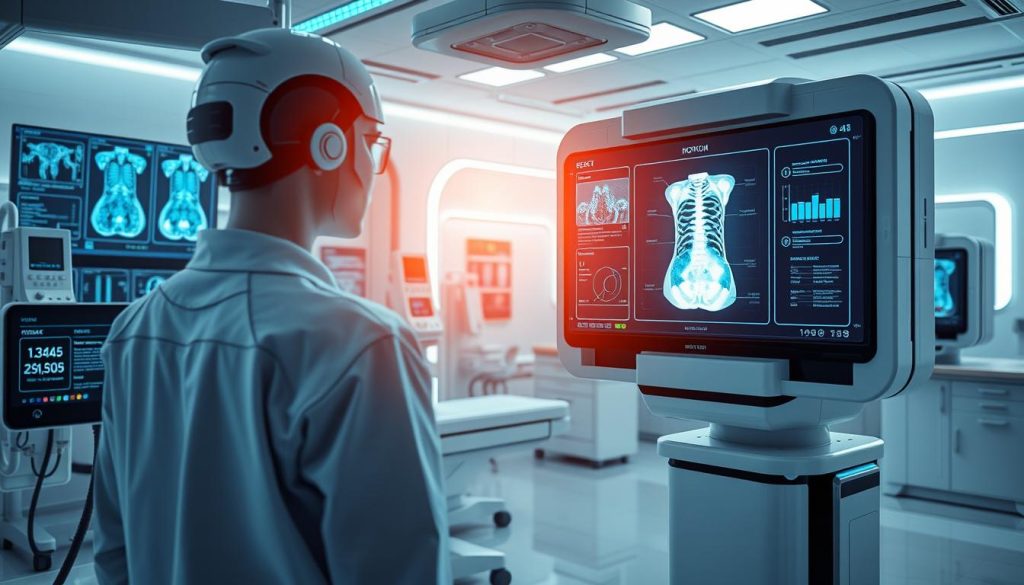
“AI-powered diagnostic tools utilizing deep learning algorithms can rapidly and accurately detect abnormalities, such as tumors and eye diseases, improving early disease detection.”
AI-Powered Predictive Analytics in Healthcare
The healthcare world is changing fast, thanks to AI and predictive analytics. These tools are changing how doctors find diseases, assess risks, and manage health for many people.
Early Disease Detection Systems
AI can look through lots of patient data to find early signs of diseases. This helps doctors act early to stop diseases like cancer and Alzheimer’s. It makes patients’ health better.
Risk Assessment Models
Predictive analytics help create strong risk models. These AI systems use data like genes and lifestyle to guess who might get sick. This lets doctors tailor treatments and make care safer and better.
Population Health Management
AI is also changing how we manage health for groups. It looks at big data to predict outbreaks and find at-risk groups. This helps health systems use resources better and keep more people healthy.
Using predictive analytics in healthcare is a big step forward. It leads to finding diseases early, better risk checks, and better health for everyone. As AI gets used more, patients will get better care that’s also more affordable.
“AI predictive analytics leverages advanced algorithms and machine learning (ML) techniques to analyze vast amounts of patient data for forecasting outcomes with enhanced precision.”
Revolutionizing Drug Discovery and Development
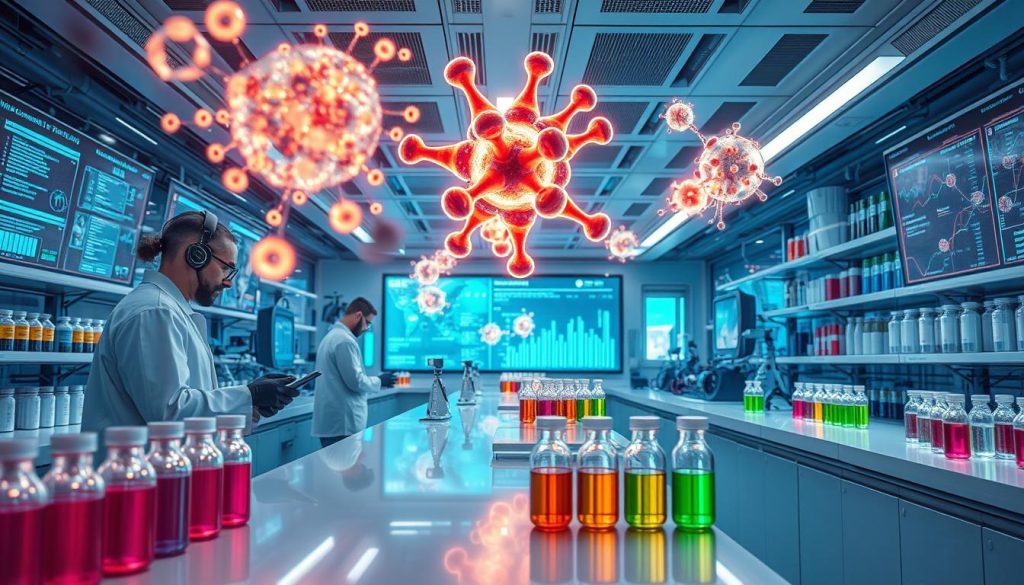
Artificial Intelligence (AI) is changing the pharmaceutical world. It speeds up finding and developing new drugs. AI looks through huge amounts of biological data to find potential drugs quickly and accurately.
Thanks to machine learning, AI can test how compounds work in the body. This cuts down the time and money needed for old-style clinical trials. AI also finds new uses for drugs we already know, getting treatments to patients faster.
AI has already made big steps in finding new drugs. For example, it found a new antibiotic called halicin by checking 2,500 molecules. This shows AI’s big potential in solving health problems.
AI is also key in pharmaceutical research and clinical trials. It uses big data to spot risks and make trials better. This makes drug development faster and cheaper.
As AI becomes more common in healthcare, its future in drug discovery looks bright. It will speed up research, cut costs, and help more people. AI is set to change how we find new medicines, helping patients everywhere.
“The traditional drug discovery process typically takes 10 to 15 years and involves billions of dollars, but the current effectiveness rate is only about 10%. AI can drastically reduce this time and cost, while also improving the chances of success.”
Modern Healthcare: Personalized Medicine and Treatment Planning
Artificial intelligence (AI) is changing personalized medicine. It helps doctors create treatment plans that fit each patient’s needs. This is made possible by analyzing a person’s genes, lifestyle, and health history.
Genetic Analysis and Treatment Customization
AI uses genetic analysis to look deeper into a patient’s DNA. It finds genetic differences that affect how they react to treatments. This leads to treatment customization, making sure each patient gets the best care.
Patient-Specific Care Protocols
AI-driven patient-centric care takes personalized medicine further. It considers a person’s genes, health history, and lifestyle. This creates a treatment plan that meets their specific needs.
This approach lets patients take a more active role in their health. It leads to better health outcomes and a stronger sense of control over their well-being.
Treatment Outcome Prediction
AI is also key in predicting treatment outcomes. It analyzes big data to guess how a patient will react to a treatment. This helps doctors make better choices and avoid bad side effects.
This predictive power is a big step towards personalized, patient-focused care.
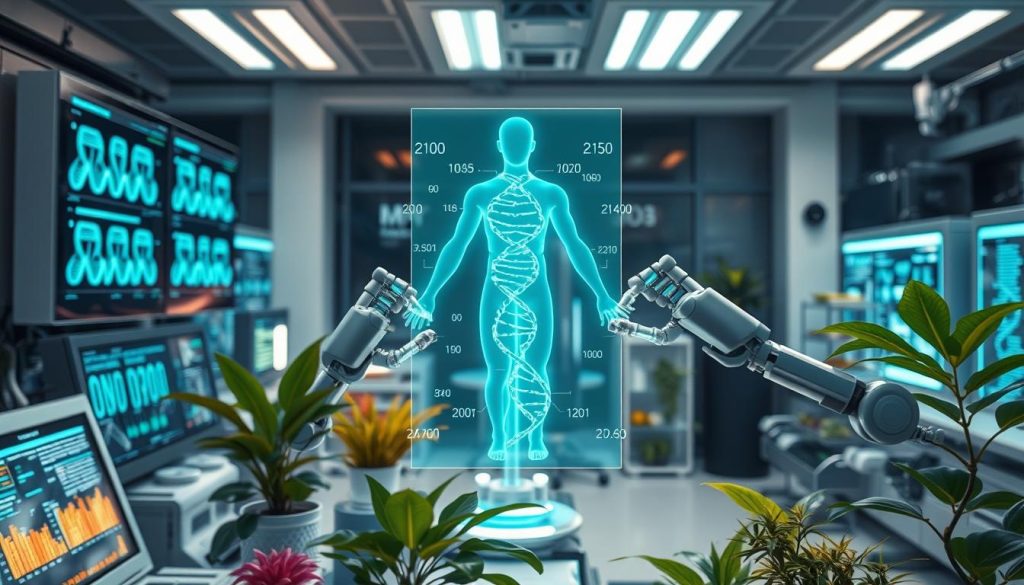
“Personalized medicine is the future of healthcare, empowering patients and transforming the way we approach treatment and prevention.”
AI in Medical Imaging and Diagnostics in Modern Healthcare
Artificial intelligence (AI) is changing healthcare a lot. It’s making medical imaging and diagnostics better. Medical imaging, like X-rays and MRIs, helps find and diagnose diseases early. AI is making these tools more precise and efficient.
AI uses deep learning to look at medical images in new ways. It can spot things that humans might miss. This leads to better and earlier diagnoses, especially in tough cases.
AI is making a big difference in many medical fields. In radiology, it can find diseases like pneumonia and breast cancer with high accuracy. It’s also helping in pathology and cardiology, making diagnoses more accurate.
| AI Technique | Application in Medical Imaging | Accuracy Improvement |
|---|---|---|
| Supervised Learning | Image segmentation, object detection, and disease classification | Up to 95% accuracy in detecting various medical conditions |
| Unsupervised Learning | Autonomous pattern identification in medical imaging datasets | Enhanced anomaly detection for early diagnosis of diseases |
| Deep Learning | Interpretation of complex medical images, such as echocardiograms and CT scans | Outperforming human experts in tasks like pneumonia detection from chest X-rays |
AI is getting better, and so is medical imaging. It’s making diagnoses more accurate and treatment plans more personal. The future of AI in healthcare looks bright, with better patient care and fewer mistakes.
“AI algorithms excel in image recognition tasks, like identifying anatomical structures and abnormalities in medical images.”
Streamlining Modern Healthcare Administration
Artificial intelligence (AI) is changing healthcare administration fast. It’s making tasks like scheduling and claims processing better. This helps healthcare providers give better care to patients.
Automated Scheduling Systems
AI chatbots and virtual assistants are making scheduling easier. They answer questions, book appointments, and send reminders. This lets healthcare providers spend more time with patients.
By doing these tasks, healthcare places can work more efficiently. They can also make patients happier and more satisfied.
Electronic Health Records Management
AI is also changing how we manage electronic health records (EHRs). It helps sort and analyze patient data. This lets doctors make better decisions and give care that’s just right for each patient.
This change saves time and makes patient records more accurate. It leads to better health outcomes for everyone.
Optimizing Claims Processing
AI is making claims processing faster and more accurate. It checks if patients are eligible and handles claims quickly. This reduces errors and speeds up getting paid.
Healthcare places can then focus on caring for patients. This makes them more financially stable too.
Using AI in healthcare administration is smart. It makes things more efficient and patient care better. As healthcare changes, AI will play an even bigger role in making care more focused on patients.
“AI is transforming the way healthcare organizations manage their administrative tasks, allowing them to focus on what truly matters – providing exceptional patient care.”
Remote Patient Monitoring and Telemedicine in Modern Healthcare
Artificial Intelligence (AI) is changing healthcare a lot. It’s making remote patient monitoring and telemedicine better. Now, doctors can care for patients from anywhere, not just in hospitals.
AI helps with telemedicine by making online doctor visits easy. It looks at patient data and helps doctors give care from afar. Remote patient monitoring devices track health signs and activity, helping patients manage their health better.
AI in healthcare has shown great results. Patients have seen a 12% drop in disease markers and a 28% less severe symptoms. Their health has also improved by 18%. Using these technologies has cut healthcare costs by 52% for direct costs and 50% for indirect costs.
| Metric | Before AI-Powered Technologies | After AI-Powered Technologies | p-value |
|---|---|---|---|
| Disease-specific markers | 12,000 | 11,000 | 0.002 |
| Symptom severity | 3,500 | 2,500 | |
| Health status | 7,200 | 8,500 | |
| Direct healthcare costs | $25,000 | $12,000 | |
| Indirect healthcare costs | $ | $ | 0.004 |
AI in telemedicine and remote patient monitoring has also made patients happier. They’re more satisfied with communication and find services more convenient. This has led to a 15% better patient satisfaction.
These technologies have also made healthcare more accessible. They’ve increased service availability by 25%, especially for those in rural areas. Fewer visits, from 2.5 to 1.5, show how efficient these solutions are.
As healthcare keeps changing, AI will be key. It will help make healthcare more patient-focused, accessible, and affordable.
AI-Enhanced Surgical Procedures in Modern Healthcare
Artificial intelligence (AI) has changed surgery for the better. It makes operations more precise and efficient. This leads to better results for patients.
Robotic surgery systems use AI to help doctors with tricky procedures. They offer more control and accuracy. This means fewer complications and quicker recovery times.
These systems use AI to analyze data in real-time. They guide surgeons during operations. They also adjust techniques based on each patient’s needs.
Robotic Surgery Advancements
AI-driven robotic surgery is a big leap forward. It combines imaging data with new technologies. This creates 3D models of the surgical area in real-time.
Surgeons can see important structures clearly. This leads to faster surgeries and fewer complications. Many hospitals have seen these benefits.
Surgical Planning and Navigation
AI helps plan surgeries based on past data. It predicts outcomes and tailors treatment plans. This makes surgeries more effective and efficient.
AI also guides surgeons during operations. It uses imaging data to improve precision. This helps doctors make better decisions during complex surgeries.
Post-operative Care Monitoring
AI’s role doesn’t stop after surgery. It helps monitor patients after operations. These systems watch for any issues and alert doctors.
AI tracks patient recovery and uses data to predict outcomes. This ensures patients get the care they need quickly. It leads to better health outcomes overall.