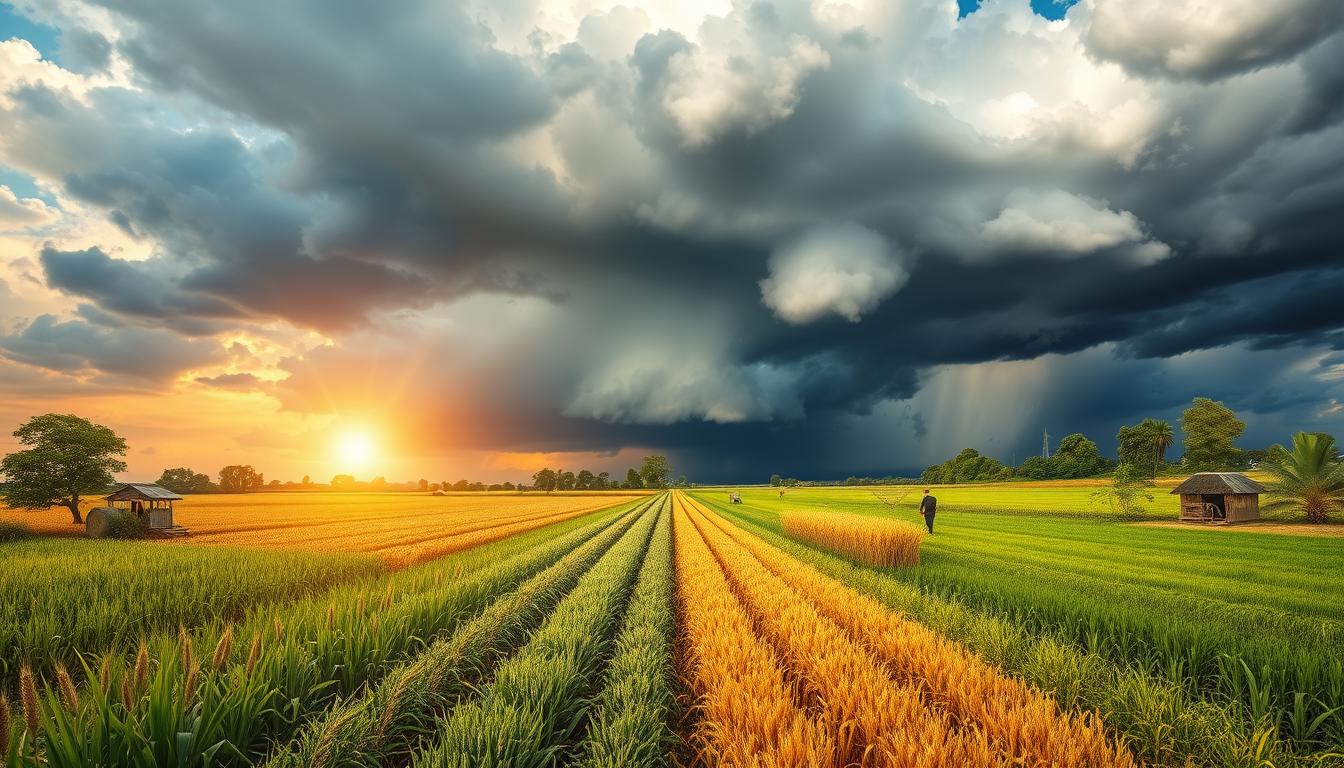
Climate change is a big problem for global agriculture. Greenhouse gas emissions from farming have grown a lot, now 18 times higher than in the 1960s. This accounts for about 30% of global warming. The health of people and nature depends on how well food is produced.
Climate change makes farming harder. It shrinks harvests and makes synthetic inputs less effective. It also speeds up damage from pests and soil erosion.
Key Takeaways
- Greenhouse gas emissions from agriculture have increased significantly over the past decades, contributing to about 30% of global warming.
- Climate change impacts various agricultural practices, including increased water use and scarcity, emissions of greenhouse gases, soil degradation, and biodiversity loss.
- Sustainable agricultural practices and technologies can help reduce agricultural emissions and mitigate the effects of climate change on food production.
- Addressing the challenges posed by climate change on global agriculture requires a collaborative approach involving multiple stakeholders.
- Reducing food waste and overconsumption of meat can contribute to lowering climate risks and feedback effects in the agricultural sector.
Understanding Global Agriculture in a Changing Climate
The world is facing big challenges from climate change. Global agri-food systems, which feed our growing population, are key. They are closely tied to our environment’s health. Today, they emit one-third of all greenhouse gases.
By 2050, the world’s population will hit 9.7 billion. This will put even more pressure on these systems.
Current State of Agricultural Systems
Food systems are the biggest source of methane and cause a lot of biodiversity loss. They use 70% of the world’s fresh water. If food waste were a country, it would be the third biggest emitter.
Yet, the agricultural sector gets only 4% of climate finance. It emits one-third of global greenhouse gases.
Key Environmental Challenges
- Nutrient pollution from too much fertilizer
- Habitat loss and degradation from land-use changes
- Soil degradation and erosion
Climate Change as a Driving Force
Climate change makes agriculture’s environmental impacts worse. It creates feedback loops that threaten to worsen these issues. The sector faces rising temperatures, heavy rainfall, droughts, and storms.
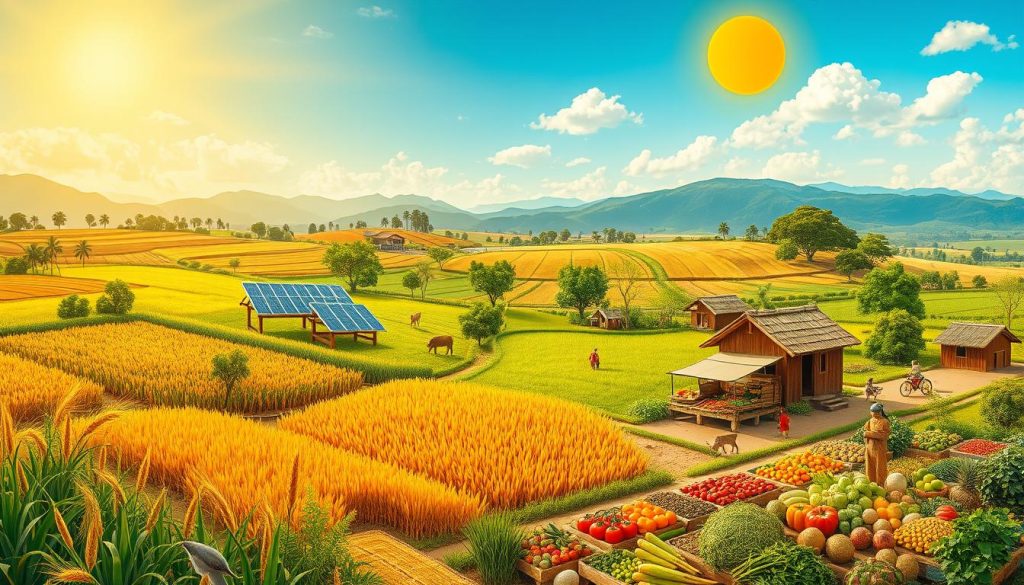
The agricultural sector must adapt to climate change. It needs to increase CO2 storage in soil and biomass. Agroforestry systems can make farms more resilient.
But, small farmers lack resources and knowledge to adapt. This highlights the need for targeted policies and support.
| Key Statistic | Impact |
|---|---|
| Agriculture accounts for about 12% of global anthropogenic greenhouse gas emissions. | The agricultural sector must reduce its environmental footprint to mitigate climate change. |
| The food system as a whole contributes to approximately 30% of global anthropogenic emissions. | Comprehensive strategies are needed to address the entire food system’s climate impact. |
| Smallholder farmers in developing countries face challenges adapting to climate change due to limited resources and knowledge. | Targeted support and capacity-building are crucial to help small-scale farmers build resilience. |
In response to these challenges, climate-smart agriculture initiatives aim to reduce emissions and enhance resilience. With the right policies, investments, and innovations, agri-food systems can become sustainable and resilient. This will ensure food security and environmental protection for future generations.
Climate Change’s Direct Effects on Crop Production
Climate change is a big threat to global food production. It makes it hard to meet the growing demand for food. The effects of climate change on crops are complex and can harm food security.
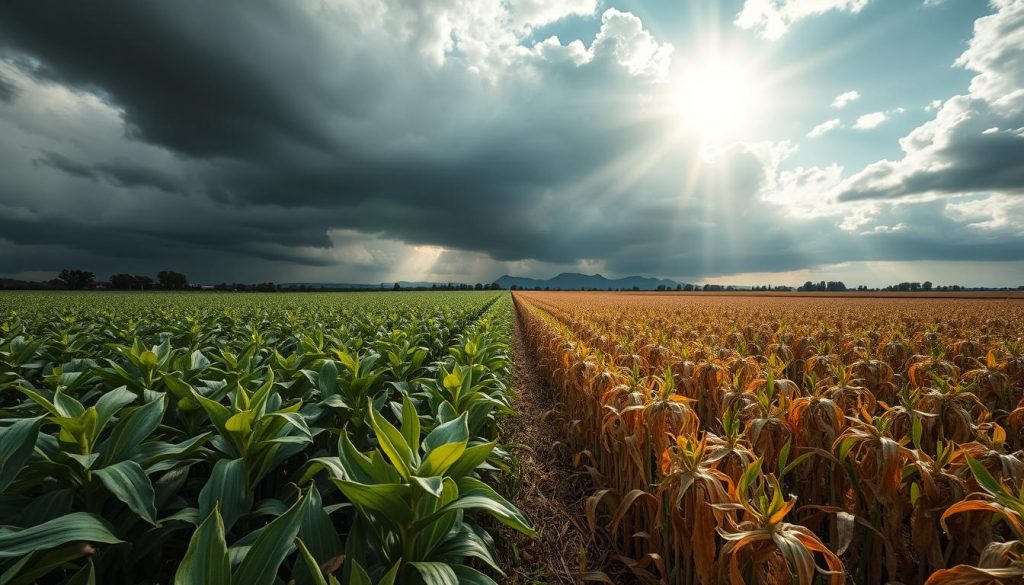
In the lowest warming scenario (RCP2.6), maize yields might drop by about 6%. But in the most extreme scenario (RCP8.5), with 3°C to 5°C warming, maize yields could fall by about 24%. Maize, grown in warmer areas, will likely see a drop in productivity worldwide due to climate change. Even in cooler places like Europe, maize yields could decrease by up to 20%.
On the other hand, wheat yields are expected to rise globally, by about 18% in the most extreme warming scenario (RCP8.5). But without carbon fertilization, wheat yields could drop by 6.6% at 2°C warming. Rice and soybean yields might see smaller impacts than maize and wheat under climate change.
Climate Change Impact
The impact’s severity varies by region. Farmers in tropical and subtropical areas might face big yield drops with less ability to adapt. But high-latitude or temperate countries could see yield increases. Maize-growing areas like the United States, China, South America, and Sub-Saharan Africa could see yields fall by 20% to 25% in extreme scenarios. Wheat production in Europe and parts of northern India might increase.
These changes in crop yields, along with more extreme weather, could make crop production and food prices more unstable. Climate change could add 8 to 80 million people at risk of hunger by 2050. This depends on future warming and how well we adapt.
It’s key to tackle climate change’s effects on crops to ensure global food security. We need to support sustainable farming that can adapt to climate change. Investing in climate-smart farming, like drought-tolerant crops and precision farming, can help reduce risks and protect global agriculture’s future.
Rising Greenhouse Gas Emissions in Agricultural Practices
The agricultural sector is a big contributor to global greenhouse gas emissions. As the world’s population grows, so does the demand for food. This has made the environmental impact of farming a pressing concern. From methane-releasing rice paddies to nitrous oxide from fertilizer, farming is a major cause of climate change.
Methane Emissions from Rice Paddies
Rice is a staple food for over half the world’s population. But the flooded fields needed for rice cultivation are a major source of methane. Methane from rice paddies is a big part of agricultural greenhouse gas emissions. This shows we need more sustainable ways to grow rice.
Nitrous Oxide from Fertilizer Use
The use of synthetic chemical fertilizers in modern agriculture has increased nitrous oxide emissions. Bacteria in the soil break down these fertilizers, releasing nitrous oxide. This gas is 300 times more potent than carbon dioxide. To reduce these emissions, we need to optimize fertilizer use and explore alternative nutrient sources.
Carbon Release from Soil Degradation
Intensive agricultural practices, like excessive tillage and soil degradation, can release stored carbon. This contributes to climate change. To combat this, we need to preserve soil health and use regenerative farming techniques. These methods can help sequester carbon and reduce the industry’s carbon footprint.
| Greenhouse Gas Emissions Source | Contribution to Total Agricultural Emissions |
|---|---|
| Enteric fermentation (livestock digestion) | 43% |
| Manure management | 10% |
| Rice cultivation | 10% |
| Synthetic fertilizers | 12% |
| Other agricultural sources | 25% |
The agricultural sector’s greenhouse gas emissions are complex. Various sources contribute to the overall impact. To address these emissions, we need a multifaceted approach. This includes innovations in agricultural technology, better farm inputs, and sustainable soil conservation practices.
“Reducing greenhouse gas emissions from agriculture is crucial for mitigating climate change and ensuring a sustainable food system for the future.”
Global Agriculture: Water Resources and Agricultural Sustainability
The global climate is changing, making water management key for farming. Farming uses a lot of the world’s freshwater, showing the need for water conservation. With climate change and more people, saving water in farming is critical.
Drip irrigation is a top way to save water in farming. It cuts down on water lost to evaporation and runoff. This method helps crops grow better and saves water. Also, storing water for irrigation helps during dry times, keeping farming going.
Using irrigation scheduling based on crops and soil helps farmers use water better. Improving soil health with compost and mulch also saves water. This is because soil holds onto water better and needs less.
Using conservation tillage and products like Aqua-Pam™ keeps soil in good shape. It stops erosion and keeps water in the soil. Crop rotation also saves water and improves soil by changing crops.
Choosing water-efficient crop varieties helps use less water. These crops use less water and can handle climate change better. Rotational grazing in livestock also saves water by keeping pastures healthy.
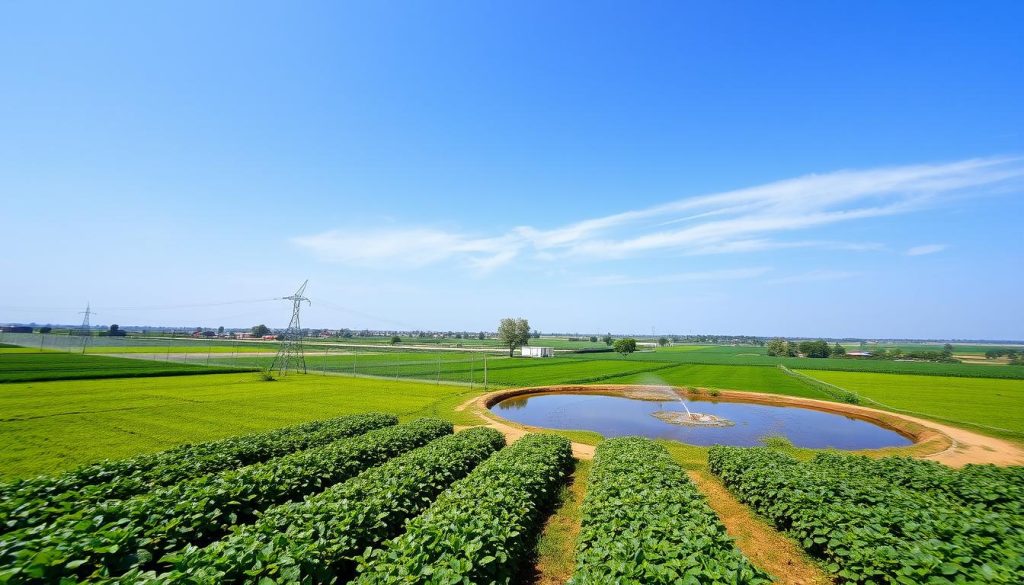
As the world’s population grows, we’ll need more food and water. By 2050, we might need 30% more water for farming. It’s vital to manage and conserve water in farming to feed everyone as the climate changes.
Global Agriculture: Impact on Soil Health and Fertility
Climate change is a big threat to our soils, which are key to farming worldwide. It causes soil erosion, losing nutrients and organic matter. This makes soil less productive, leading farmers to use more chemicals.
Soil Erosion Patterns
Climate change brings more rain, droughts, and extreme weather. These changes upset the soil balance. Soil erosion increases, taking away the topsoil full of nutrients. This hurts plant growth and adds to the climate problem.
Nutrient Depletion Issues
Soil erosion and lost organic matter mean fewer nutrients for plants. This makes the soil less fertile. To fix this, farmers use synthetic fertilizers, which harm the environment.
Organic Matter Loss
Climate change makes it hard to keep organic matter in soils. This matter is vital for soil health, supporting microbes and holding water. Without it, soil health and fertility suffer.
Soil health is more important than ever with climate change. We need new ways to care for our soil. Practices like regenerative agriculture can help, by keeping soil intact and sequestering carbon.
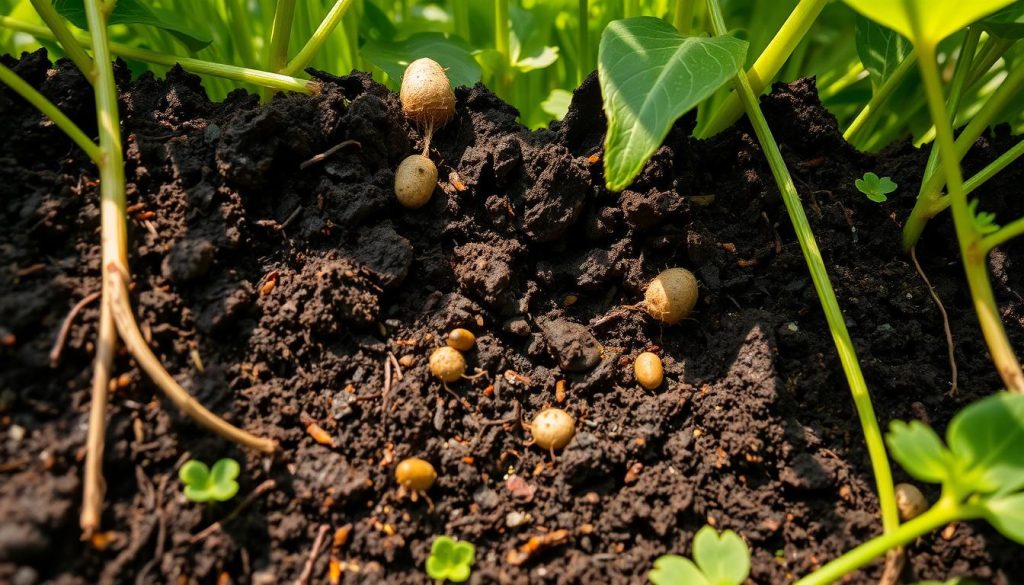
| Soil Health Indicator | Conventional Agriculture | Regenerative Agriculture |
|---|---|---|
| Soil Organic Carbon | Low | High |
| Soil Biodiversity | Low | High |
| Nutrient Cycling | Dependent on Synthetic Inputs | Efficient Natural Cycling |
| Erosion Resistance | Low | High |
| Water Holding Capacity | Low | High |
“Healthy soils enable carbon sequestration and soil fertility, supporting improved crop yields and quality.”
Global Agriculture: Climate-Smart Agricultural Solutions
The world faces big challenges from climate change. Climate-smart agriculture is a new way to help. It makes farming better for the planet and helps farmers too. This method combines farming, climate, and sustainability in a new way.
Soil health and carbon storage are key in this approach. Cover crops, no-till farming, and crop diversification help soil hold more carbon. This reduces harmful gases in the air. Agroforestry adds trees to farms, improving soil and helping farmers make more money.
New tech in precision agriculture and digital farming solutions also helps. It lets farmers use fertilizers and water better. This cuts down on pollution and harmful gases. It makes farming better for the planet and more ready for climate changes.
Switching to climate-smart agriculture is very promising. It focuses on soil health, biodiversity, and using resources wisely. This way, farming can be more sustainable and strong against climate changes.
“Climate-smart agriculture aims to increase productivity in an environmentally and socially sustainable way, strengthen farmers’ resilience to climate change, and reduce greenhouse gas emissions from agriculture where possible.”
Global Agriculture: Sustainable Farming Technologies and Innovations
In the face of climate change, new farming technologies are key. They help agriculture adapt and grow. These include precision agriculture and digital farming solutions, changing how we produce food.
Precision Agriculture Adoption
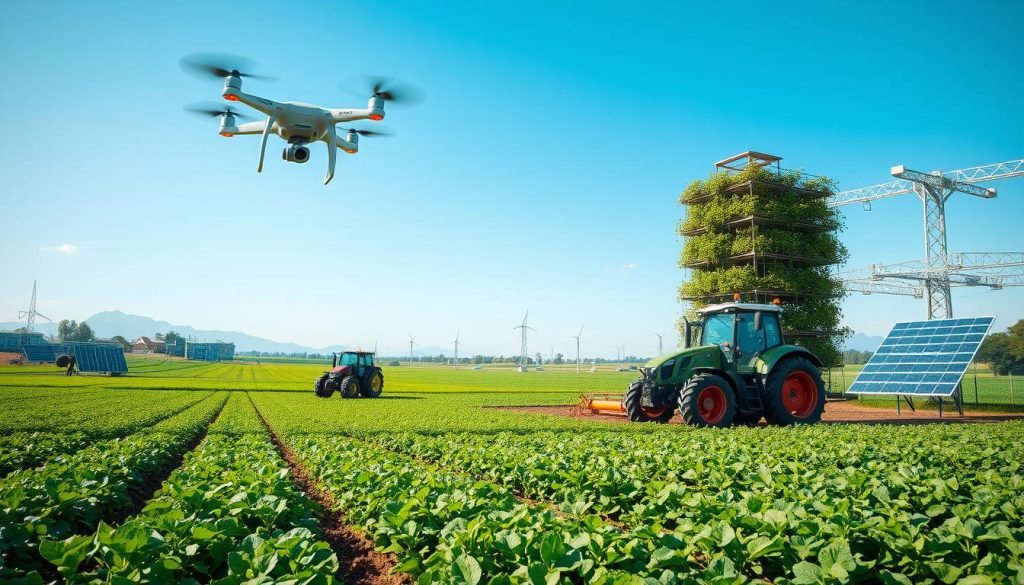
Precision agriculture lets farmers manage their fields better. They use GPS, IoT devices, and data to make smart choices. This reduces waste and protects the environment.
Digital Farming Solutions
Digital farming is changing agriculture. Big data analytics help farmers understand their crops better. Drones with sensors give detailed views of crops. Automated machinery makes farming more efficient and safer for workers.
Crop Diversification Strategies
Planting different crops helps farms face climate change. Biotechnology, like CRISPR gene editing, creates stronger crops. Sustainable practices like integrated pest management and regenerative agriculture also help.
Using agtech innovations, precision agriculture, and farm management systems is vital. They help tackle climate change and ensure food for everyone. Working together is key to making these technologies available to all.
Global Food Security Challenges in Global Agriculture
Global food security faces many challenges, especially with climate change. Crop yields are falling, and the environment is under more pressure. This makes it hard to keep food production stable worldwide. Climate change also disrupts trade and markets, making food security even harder to achieve.
In 2024, there was a big drop in global hunger. About 313 million fewer people were struggling to find food, a 27.5% decrease from 2023. By 2034, it’s hoped that only 5.5% of the world’s population will face food insecurity, down from 66.7% now.
Improving economies is key to this progress. In 2024, 80 countries are expected to see their per capita GDP grow, at an average of 3.4%. The Former Soviet Union and Asia are expected to lead with growth rates of 5.1% and 4.7%, respectively.
But, there are still hurdles. Inflation, severe weather, and supply chain problems have raised food prices from 2021 to 2023. To solve this, we need a wide-ranging plan. This plan should focus on rural development, sustainable farming, and fair food distribution.
| Region | Estimated Food Insecurity (2024) | Projected Food Insecurity Reduction (by 2034) |
|---|---|---|
| Asia | 29.3% | 66.7% |
| Sub-Saharan Africa | 29.3% | 66.7% |
| Former Soviet Union | 5.1% | 66.7% |
| Other Regions | 5.5% | 66.7% |
The world has made progress in food security, thanks to efforts like the Zero Hunger Challenge and the Scaling-Up Nutrition (SUN) Movement. These efforts aim to ensure everyone has access to safe, nutritious food. But, we still have a lot to do, especially in supporting small farmers and using sustainable farming methods.
To ensure no one goes hungry, we need a comprehensive approach. This should include improving rural areas, supporting international trade, and using climate-smart farming. With these steps, we can make the world’s food systems resilient and sustainable for everyone.
Conclusion
Climate change has a big impact on farming worldwide. We need a strong plan to tackle these issues. By using climate resilience and sustainable farming, we can make farming better. This will help feed the world even as the climate changes.
Innovative agribusiness innovation and new farming tech are key. They show us how farming can succeed despite climate changes.
Many places are starting to make a difference. In Bolivia, 2,600 groups have helped 107,308 families. In Brazil, a program aims to help 900,000 farmers. And in Ethiopia, a project helped 2.5 million farmers grow more and sell more.
These stories show how important it is to work together. They show that with the right help, farming can thrive.
The 2024 GAP Report says we need to change how we help farming. We must invest in new farming ideas and help farmers get to market. By doing this, we can grow food faster and meet the world’s needs.
Working together, we can make farming better. We can make it strong against climate change. And we can help make the world a better place for everyone.