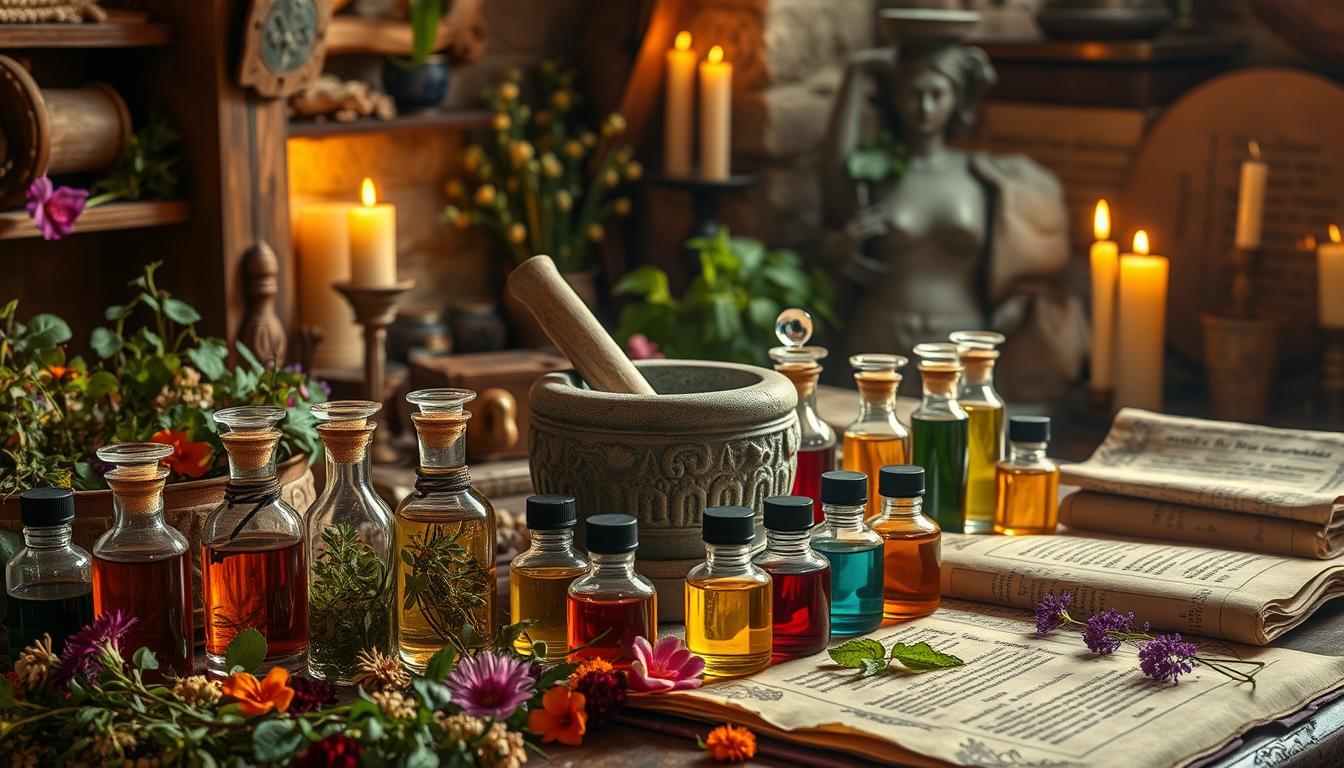
The history of perfume is a fascinating journey that goes back thousands of years. It started in ancient places like Egypt and Mesopotamia. At first, perfumes were used for religious rituals and to show social status. But over time, they have become more than that, crossing cultural lines and shaping our world.
Perfumes have a special connection to our memories. They can bring back emotions and leave a lasting impression. This makes them very powerful.
From the first distillation methods to today’s synthetic scents, perfume shows our creativity and ingenuity. The perfume industry has changed with society, influencing culture and the economy in many ways.
In this deep dive, we explore perfume’s rich history. We’ll look at its origins, key figures, and important moments. Join us as we discover the scents that have shaped history.
Key Takeaways
- Perfume’s origins can be traced back to ancient civilizations, where it was used for religious rituals and as a status symbol.
- The term “perfume” is derived from the Latin phrase “per fumus,” meaning “through smoke,” reflecting the early use of fragrant resins and oils.
- Distillation techniques, pioneered by Arab and Persian chemists, revolutionized the perfume-making process and led to the refinement of fragrances.
- The perfume industry has evolved from a luxury reserved for the elite to a widely accessible commodity, driven by technological advancements and marketing strategies.
- The cultural and economic impact of perfume cannot be overstated, as it has influenced trade routes, social norms, and even political power throughout history.
Ancient Origins: From Egypt to Mesopotamia
The history of perfume is fascinating, with ancient places like Egypt, Mesopotamia, and India being key. Cuneiform tablets from Mesopotamia show perfume recipes from 1800 BCE. Ayurvedic texts from India, over 3,000 years old, tell us about using natural ingredients for scents.
Egyptian Perfume Making Techniques
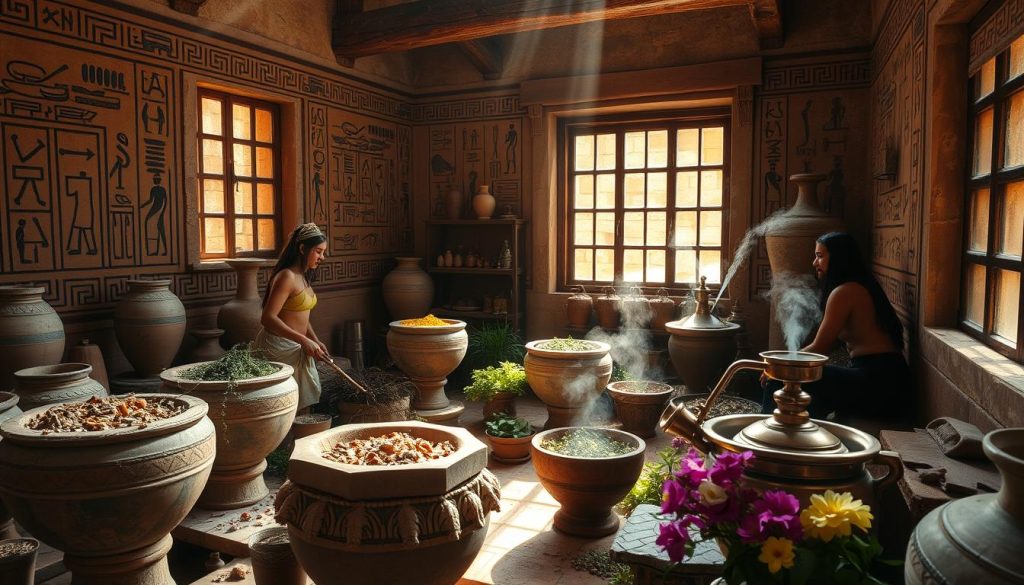
Egypt is often seen as the start of perfumery. Archaeologists found the first perfumery in Cyprus, covering 1 square kilometer. Egyptians used scents for grooming, personal care, and in religious rituals and mummification.
The Role of Kyphi in Ancient Rituals
Kyphi was a famous perfume in Egypt, used in religious ceremonies. It was made from juniper, cinnamon, raisins, myrrh, wine, and honey. This blend created a unique and intoxicating smell that was highly prized.
Early Trade Routes and Ingredients
Early trade routes helped share scents between ancient cultures. Mesopotamia, especially, played a big role in perfumery. Tapputi from Babylon is known as the first recorded perfumer.
The history of perfume-making shows our ancestors’ creativity. They captured nature’s essence and made fragrances that have lasted for centuries.
The Birth of Modern Perfumery in Medieval Times
The medieval period was a key time for medieval perfumery. In the 12th century, mixing fragrant oils with alcohol changed perfume making. This led to scents that lasted longer and were more intense.
Islamic cultures greatly influenced aromatic tradition in the 6th century. They developed steam distillation for getting perfume oils. Ibn Sina also figured out how to get oils from flowers using distillation. This was a big step forward for modern perfumery.
These important changes in the medieval period helped the perfume industry grow. The use of natural ingredients and alcohol-based formulas made perfumery more complex and sophisticated.
| Key Developments in Medieval Perfumery | Timeline |
|---|---|
| Earliest recorded use of perfumes in Mesopotamia and Egypt | 4000 years ago |
| Perfume made from attar oils, such as rose and jasmine, used in ancient Egypt | Ancient Egypt |
| First recorded perfume, a blend of myrrh, cedar, and cypress, created in Mesopotamia | Ancient Mesopotamia |
| Perfumes used for medicinal purposes and status symbols in ancient Greece and Rome | Ancient Greece and Rome |
| Advancements in perfume distillation and creation of attar oils during the Islamic Golden Age | 6th century |
| Reemergence of perfumes in medieval Europe influenced by the Islamic world | Middle Ages |
The medieval period was when modern perfumery started. It opened the door to a new world of fragrance innovation and growth.
History of Perfume: From Religious Ritual to Royal Courts
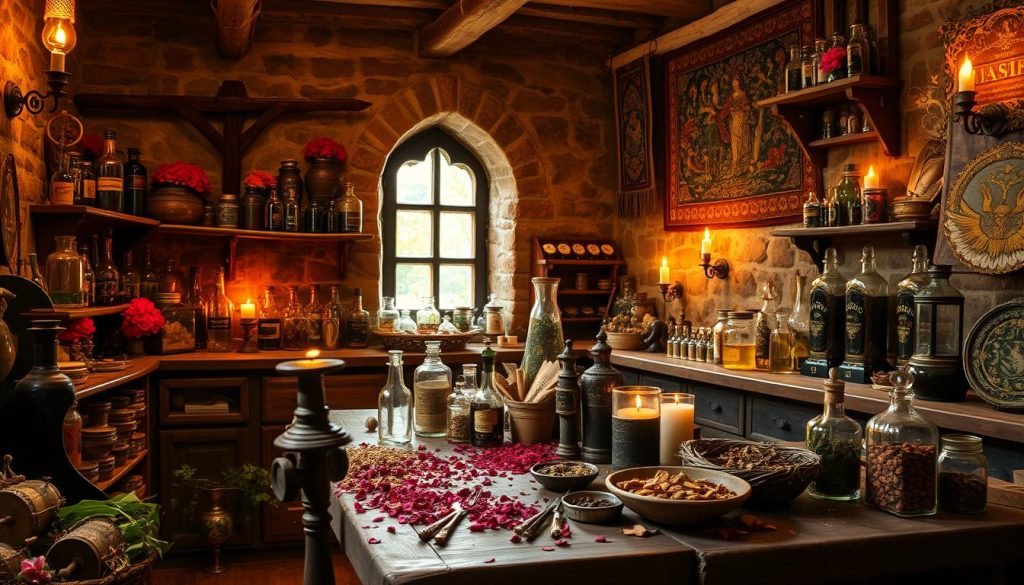
The story of perfume is fascinating. It started with ancient religious rituals and moved to the lavish courts of European royalty. As people around the world fell in love with fragrance, it changed from a sacred act to a sign of status and luxury.
The Introduction of Alcohol-Based Perfumes
A big step in perfume history was the use of alcohol-based formulas. “Hungarian Water,” made around 1370 for Queen Elisabeth of Poland, is one of the oldest. It had rosemary and thyme and became very popular, leading to more alcohol use in perfumes.
Hungarian Water and Royal Influences
Hungarian Water was a game-changer for perfume. Its scent, with rosemary and thyme, won over the European elite, including royalty. Perfume moved from being a religious item to a prized possession of the aristocracy. They used it to hide bad smells and show off their wealth and power.
Perfume as a Status Symbol
Perfume became a symbol of status and luxury in royal courts. Even Napoleon Bonaparte had his own perfumer. The European upper class made perfume a part of their daily routine. This made perfume go from a special item to something everyone used, showing its importance in perfume in different cultures and cultural significance of perfumes in literature and art.
“Perfume is the indispensable compliment to the elegance of dress.” – Coco Chanel
History of Perfume: The French Revolution and Its Impact on Perfumery
The French Revolution changed the perfume industry a lot. Before the revolution, France was the top country in perfume. But the political changes and social issues stopped perfume making in France for a while.
But, the revolution made perfume more common for everyone. As people got better at staying clean, they started liking lighter, floral, and citrus smells. This showed how people’s tastes were changing.
Also, the revolution brought new ways to sell perfume. One person even made a perfume called “Guillotine” to make money during the chaos. This showed how the industry could adapt and keep going.
The French Revolution’s impact on the perfume industry was huge. It stopped production but then made perfume more for everyone. It also started new ways to sell perfume that would last for a long time.
“The French Revolution marked a turning point in the evolution of the perfume industry, as it democratized the use of fragrances and paved the way for new marketing approaches that would define the industry’s future.”
After the French Revolution
After the French Revolution, the perfume industry in France changed a lot. France became known as the perfume capital of the world. Its perfume houses kept leading in new trends and making new fragrances.
| Statistic | Data |
|---|---|
| France’s Perfume Industry | France became the world capital of perfume in the 17th century, and the town of Grasse is known as the heart of the French perfume industry. |
| 19th Century Perfumery Revolution | The 19th century marked a revolution in perfumery with the rise of organic chemistry, as French scientists discovered how to synthesize natural aromas, expanding perfumers’ palette. |
| French Perfume Houses | Iconic French perfume houses like Guerlain (established in 1828) quickly expanded globally, reaching markets in the United States, South America, Europe, India, and Southeast Asia. |
| Modern French Perfumery | In the 21st century, a shift towards artisanal and niche perfumery emerged, focusing on originality and high-quality ingredients, diverging from the mass-market approach. |
The French Revolution’s effect on perfume was huge. It stopped production but then made perfume more for everyone. It also started new ways to sell perfume that would shape the industry for a long time. As France’s perfume industry kept growing, it became known as the perfume capital of the world. Its perfume houses and unique scents attract people from all over.
History of Perfume: The Rise of Synthetic Fragrances in the 19th Century
The 19th century was a big change for perfumery. Synthetic fragrances came in, changing the game. They brought new creativity, consistency, and cost savings to making scents.
Revolutionary Production Methods
In 1891, Eugène Rimmel made the first spray bottle. This changed how perfume was sold and used. It made perfumes more popular and easy to use.
The First Synthetic Perfumes
The 19th century also saw the first synthetic perfumes. In 1889, Houbigant launched Fougère Royale. It was a big step, making perfume making more efficient and creative.
Innovation in Perfume Packaging
The 19th century also saw big changes in perfume packaging. Perfume houses grew plants in places like Sicily and Grasse. This gave them more materials for their scents.
The 19th century was a big time for perfume. Synthetic fragrances and new ways of making them changed the industry. These changes made perfumes more available and creative, shaping how we enjoy scents today.
History of Perfume: The Golden Age of Perfumery: Early 20th Century
The early 20th century was a golden time for perfume. It saw the birth of iconic scents and new ways to market them. These changes shaped the future of perfume.
Chanel No. 5, made in 1921 by Ernest Beaux, is a legend. It was the first to use synthetic scents, changing the game. Other classics like Guerlain’s Shalimar (1925) and Jean Patou’s Joy (1930s) also made a mark. They still influence perfume today.
Designer brands like Yves Saint Laurent and Christian Dior entered the scene. They, along with Elizabeth Arden and Estée Lauder, helped shape the era. Their perfume brands and famous perfumes are still loved today.
This time was full of creativity and success. The demand for vintage perfume collections grew. The impact of these early scents is still felt in perfume today.
“The history of perfume is the history of desire.” – Edmond Roudnitska, French perfumer
Evolution of Gender in Fragrances
The idea of gendered fragrances has changed a lot over time. Until the mid-20th century, perfumes were for across the gender spectrum. But in the 1960s, fragrances for men started to appear. Edmond Roudnitska’s Eau Sauvage for Dior in 1966 became a hit, thanks to its unique scent.
Breaking Gender Stereotypes in Scents
In the late 20th and early 21st centuries, perfumery started to break gender stereotypes. Unisex fragrances became popular, and people began to enjoy scents without thinking about gender. Independent brands offered unique smells and stories, attracting many different people.
Modern Unisex Perfume Movement
Unisex perfumes are now in demand, showing a change in cultural views. These scents mix notes from both men’s and women’s fragrances. They create complex smells that many people enjoy.
Even though gender-specific perfumes are still popular, unisex fragrances show the industry’s growth. They reflect a move towards more inclusivity in gender in perfumes. This change matches broader trends of gender equality and self-expression.
“The popularity of unisex perfumes in the fragrance industry reflects changing cultural norms, with an increasing demand for inclusive products.”
History of Perfume: Modern Innovations and Artisanal Perfumery
The 21st century has brought a flood of new perfume brands and scents. Niche and indie perfumery have become big players, offering unique smells. They meet the demand for something special and personal.
Prominent perfumers mix old techniques with new tech to make bold fragrances. They’re pushing the limits of perfume art.
The idea of a “perfume wardrobe” has become popular. It means having many scents for different times and moods. This change has made people appreciate perfume making more.
Now, the perfume world focuses on being green and kind. It uses natural stuff, eco-friendly packaging, and doesn’t hurt animals. Artisanal perfumers lead this way, pleasing those who want to buy with a clear conscience.
Biotechnology has opened up new paths for fragrances. It lets us make scents that are diverse and better for the planet.