The debate between E-books vs. Printed Books goes beyond personal taste. It touches on the environment too. The publishing world is a big polluter, being the third-largest emitter of greenhouse gases. In the US, 32 million trees are cut down every year for book paper.
E-readers might seem like a greener option since they’re paperless. But, they have their own environmental costs, mainly in how they’re made. An average e-reader’s carbon footprint is about 80 pounds. That’s like the carbon from 36 small paperback books.
How much each format affects the environment depends on how we read and consume. It’s all about our individual habits and choices.
Key Takeaways
- The publishing industry is a significant contributor to global greenhouse gas emissions, with 32 million trees felled annually in the US for book paper.
- E-readers have a substantial carbon footprint during manufacturing, with an average of 80 pounds of CO2 equivalent.
- The environmental impact of reading formats depends on individual reading habits and consumption patterns.
- Printed books have a higher carbon footprint per book compared to e-readers, but the overall impact depends on the number of books read.
- Sustainability and environmental considerations are increasingly important factors in the debate between e-books and printed books.
Understanding the Digital vs. Traditional Reading Landscape
The world of reading is changing fast. Digital books are becoming more popular, but traditional printed books are still loved by many. Audiobooks and e-books each take about 15% of the U.S. book market. Print books, however, are the most common choice.
Current Market Share and Reading Trends
Even though digital reading is growing, especially among the young, print books are still more popular in the U.S. as of 2021. The industry is expected to keep changing. By 2030, readers might spend almost $174 billion on books in all formats.
Evolution of Reading Formats
The publishing world has changed a lot in recent years. E-readers and e-books are now more accessible. Every year, about 4 million new book titles come out worldwide. By 2027, there could be 1.1 billion e-book users globally.
Global Publishing Statistics
Print books are still the big players in the market. But, reading preferences change with age. Younger readers in the U.S. prefer print books more than older ones. Yet, the digital world opens up new chances for authors and publishers to reach more people and try new ways to share their work.

“The publishing industry is undergoing a remarkable transformation, with the rise of e-books and digital reading platforms alongside the enduring popularity of traditional print books.”
The Carbon Footprint of Print Book Production
The book publishing industry has a big impact on our environment. Print books, in particular, have a large carbon footprint. Studies show that a single paperback book can produce about 1 kilogram of CO2. This is like charging 122 smartphones or making two café lattes.
Penguin Random House UK says their books produce 330 grams of CO2 on average. Every year, 2.2 billion physical books are sold worldwide. This adds up to 726,000 tons of CO2, which is like powering 141,261 homes or the emissions from 161,500 cars. The main reasons for this are paper production, printing, and shipping.
| Industry | Carbon Footprint |
|---|---|
| Print book publishing | Third among all industries using pulp and paper for producing greenhouse gas emissions |
| Paper production for book manufacturing | Accounted for 6% of global industrial energy consumption in 2017 |
| Sustainable paper certified by the Forest Stewardship Council (FSC) | Reduced the average emissions of a paperback book by three times according to Penguin Random House UK |
To cut down the carbon footprint of print books, publishers are trying new things. They are using regional print-on-demand printers and more sustainable paper. They are also making sure they don’t print too much. As the book publishing world changes, making the environment better will be a big focus.

E-books vs. Printed Books: A Comprehensive Comparison
E-books and printed books have different environmental impacts. E-readers have a bigger carbon footprint at first but get better with more use. Printed books have a smaller impact per book but add up with each new one.
Manufacturing Process Impact
Kindle e-readers have a carbon footprint of about 168 kilograms of CO2. This is because of the energy needed to get raw materials and put the device together. Printed books, on the other hand, use less energy for paper, ink, and binding.
Energy Consumption Differences
E-readers use less energy than printed books. They save on shipping and production. But, they need power for charging and data. Still, they’re better for the planet if you read 15 books on them in three years.
Lifecycle Analysis
Looking at the whole life of e-books and printed books shows big differences. E-readers might start off worse but can be better for the planet over time. This is especially true for people who read a lot.
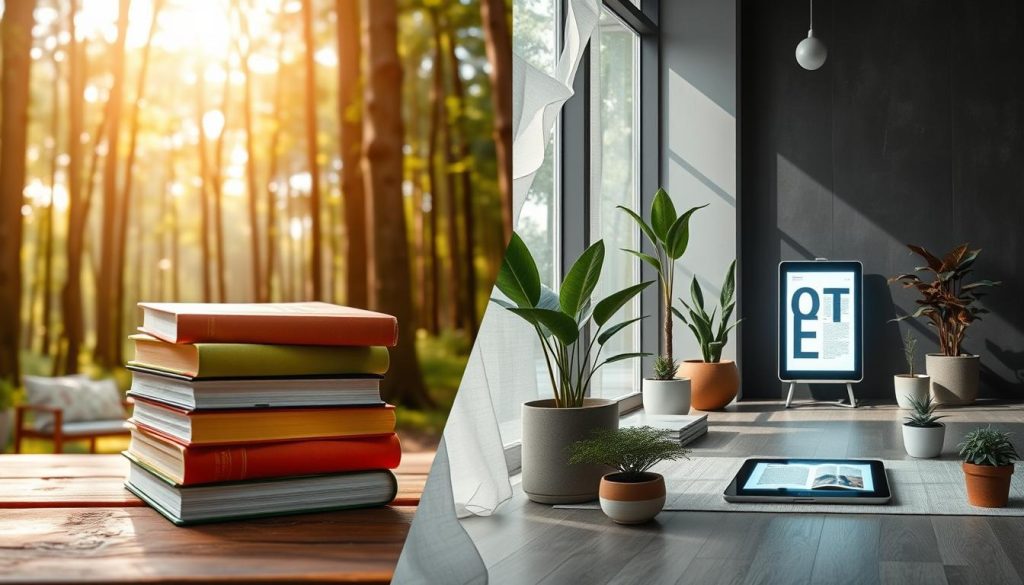
“Turning pages as we read creates an ‘index’ in the brain, mapping what we read visually to a particular page.”
The debate between e-books and printed books is ongoing. The environmental impact is just one thing to think about. Your choice might depend on what you like better, with both having their own good and bad points.
E-books vs. Printed Books: Paper Industry’s Environmental Impact
The paper industry has a big impact on our environment. It affects deforestation, water usage, and energy consumption. The publishing industry uses a lot of water, about 153 billion gallons a year. This shows how much water it needs.
Many books use recycled paper, but making new paper still harms forests. The pulp and paper industry uses a lot of energy, about 6% of global industrial energy. This adds to the environmental problems.
But, the book industry has rules to use recycled materials. Around 10% of global deforestation is because of paper book production. This is less than other causes, but still a big issue.
“The paper industry’s environmental impact is a complex and multifaceted issue, requiring a holistic approach to address the concerns of deforestation, water usage, and energy consumption.”
There are efforts to make the paper and publishing industries more sustainable. Companies like Wiley use 100% renewable energy for their printing. Big publishers like Hachette and Simon & Schuster use paper from responsibly managed forests.
But, making eco-friendly books is more expensive. This makes it hard for some companies to afford. We need to find ways to make sustainable book publishing more affordable.

E-books vs. Printed Books: Digital Device Manufacturing and Its Environmental Cost
E-reader devices are becoming more popular, but their environmental impact is significant. They offer easy access to books but also have a big environmental cost. This cost goes beyond the debate of e-books versus printed books.
Raw Material Extraction
Creating e-readers needs non-renewable materials like metals and plastics. Mining and refining these materials harm the environment. They can pollute soil, water, and increase greenhouse gases.
E-reader Production Process
The making of e-readers is very resource-heavy. It involves complex supply chains and uses harmful chemicals. This process greatly increases the carbon footprint of e-readers.
Battery and Electronic Components
The batteries and parts inside e-readers also harm the environment. Getting materials like lithium and cobalt can damage the environment. It adds to the growing electronic waste problem.
As more people want e-readers, we must think about their environmental effects. Manufacturers need to use fewer non-renewable resources. They should use more recycled materials and make production greener to lessen the environmental impact.
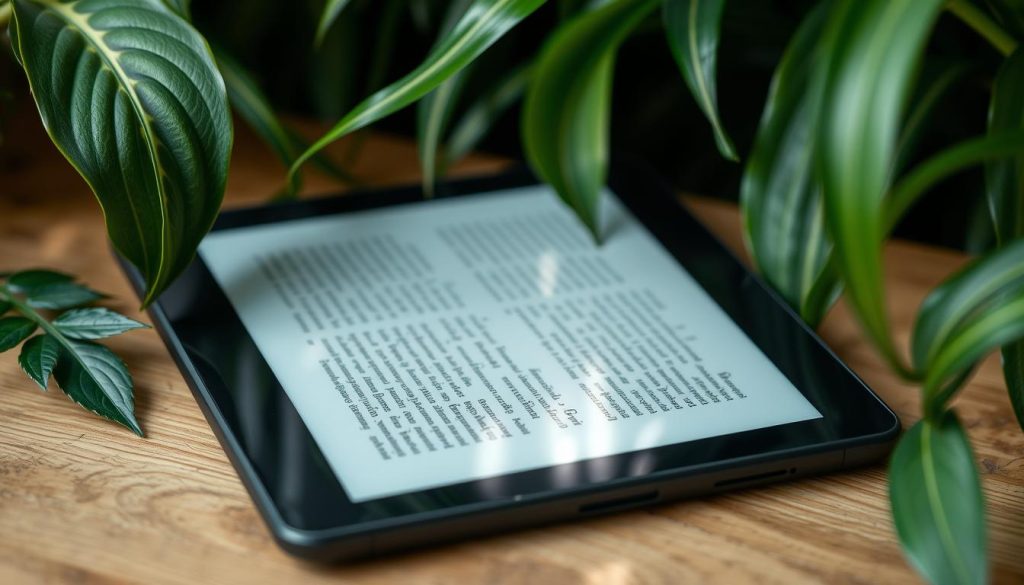
E-books vs. Printed Books: Tree Conservation and Deforestation Concerns
The book publishing industry has a big impact on forests. Every year, 32 million trees are cut down in the U.S. to make book paper. E-books and digital reading might help, but we need to change how we use them and make publishing more sustainable.
Publishing companies are trying to save trees and cut down on carbon. Penguin Random House UK uses 100% FSC-certified paper. But, some say these efforts are not enough because of “greenwashing” in forestry certifications.
The publishing world is working to be more green. They want to save trees, cut down on waste, and make books in a way that’s better for the planet. As we keep reading books, it’s important for the industry to keep protecting our forests and promoting sustainability.
| Statistic | Impact |
|---|---|
| About 3.4 billion trees are felled per decade to create books. | Significant deforestation caused by the book publishing industry. |
| More than 16,000 truckloads worth of books are wasted every year. | Excessive waste and resource consumption in the book industry. |
| 26% of trash worldwide consists of discarded paper and paperboard. | The book industry contributes to a substantial portion of global waste. |
The publishing world needs to focus on saving trees and reducing waste. This is key for making books that are good for the planet. As we keep reading, it’s vital for the industry to find a balance between making books and protecting our forests.
“Sustainable forestry practices and the responsible use of paper-based products are essential for the future of our planet.”
Energy Consumption in Digital Reading
The world of digital reading is changing fast. We need to look at how much energy it uses. E-readers are easy to carry and read on, but we can’t ignore the energy they need.
Power Usage for E-readers
E-readers use special screens that don’t use much power. They can go weeks or months without needing to be charged. This is a big plus compared to old LCD screens that need to be charged more often.
Things like adjustable fonts and blue light filters make reading better. They also help your eyes and sleep. These features are why more people are choosing digital reading.
Data Center Impact
E-readers themselves don’t use a lot of energy. But the big picture is different. The data centers that store and send e-books use a lot of power. This makes e-readers have a bigger carbon footprint.
Data centers are key for digital reading to work well. They need a lot of electricity for their servers and cooling systems. This makes the digital reading world more energy-hungry and bad for the environment.
As more people read digitally, we must think about energy use. We need to find ways to make digital reading greener. This will help reduce its environmental impact.
E-books vs. Printed Books: Sustainable Practices in Book Publishing
The book publishing industry is moving towards a greener future. Publishers like Chronicle Books are cutting down on initial print runs. They’re also using materials like cotton-based upcycled paper for eco-friendly books.
Harper Collins has introduced sustainable fonts. These fonts use less ink, saving over 200 million pages across 227 titles.
On-demand printing is becoming more popular. It helps reduce waste from unsold books. Some leaders are working to make traditional print more sustainable, not just switching to digital.
Many publishers are using recycled and FSC-certified paper. This reduces the need for new wood and helps save forests. E-books and audiobooks are also becoming more popular. They cut down on the need for physical materials and transportation, lowering the environmental impact.
Working together is key for sustainable publishing. Authors, publishers, and environmental groups are finding new ways to be green. As people want more sustainable products, the industry is ready to make a change.
“The publishing industry has a responsibility to reduce its carbon footprint and lead the way in sustainable practices. By adopting eco-friendly strategies, we can minimize the environmental impact of book production and distribution.”
E-reader Lifespan and Electronic Waste
E-readers are getting more popular, but their short lifespan is a big problem. They usually last 3 to 5 years, much less than a print book’s life span. This short time leads to a lot of electronic waste, which harms the environment because of the complex parts and batteries.
Device Longevity
E-readers are handy and easy to carry, but they don’t last long. In contrast, physical books can last for decades or even centuries if taken care of. This difference is key when thinking about the environmental effects of e-readers versus print books.
Recycling Programs
Many makers of e-readers, like Amazon, have recycling programs to deal with e-waste. But, how well these programs work depends on people using them. It’s hard to recycle e-readers because of their complex parts and batteries. On the other hand, print books are easier to recycle or break down, but they often end up in landfills.
The choice between e-readers and print books is complex. Both have their own environmental challenges. As readers, we should think about the impact of our choices. This helps us make decisions that are better for the planet.
| Product | Lifespan | Recyclability | Environmental Impact |
|---|---|---|---|
| E-reader | 3-5 years | Requires specialized recycling | Contributes to electronic waste |
| Print Book | 30-100 years | Generally easy to recycle or biodegrade | Concerns regarding paper production and waste |
E-books vs. Printed Books: Breaking Even: The Environmental Tipping Point
The debate over e-books versus printed books touches on many factors. It’s all about how often you read. Studies show that e-readers are better for the planet if you read 15 or more books on them. This is especially true for those who read on an iPad, where 25 books are the magic number.
But, if you don’t read much or prefer buying second-hand, print might be greener. It’s all about your reading habits and choices.
Upgrading devices and mixing digital and print books also play a role. For those who buy lots of books, e-readers are better in the long run. They use less paper and cut down on emissions from shipping.
So, what’s the best choice? It depends on you and your reading style. We need to look at our own habits and choices. This way, we can pick the option that’s best for the planet and fits our reading needs.