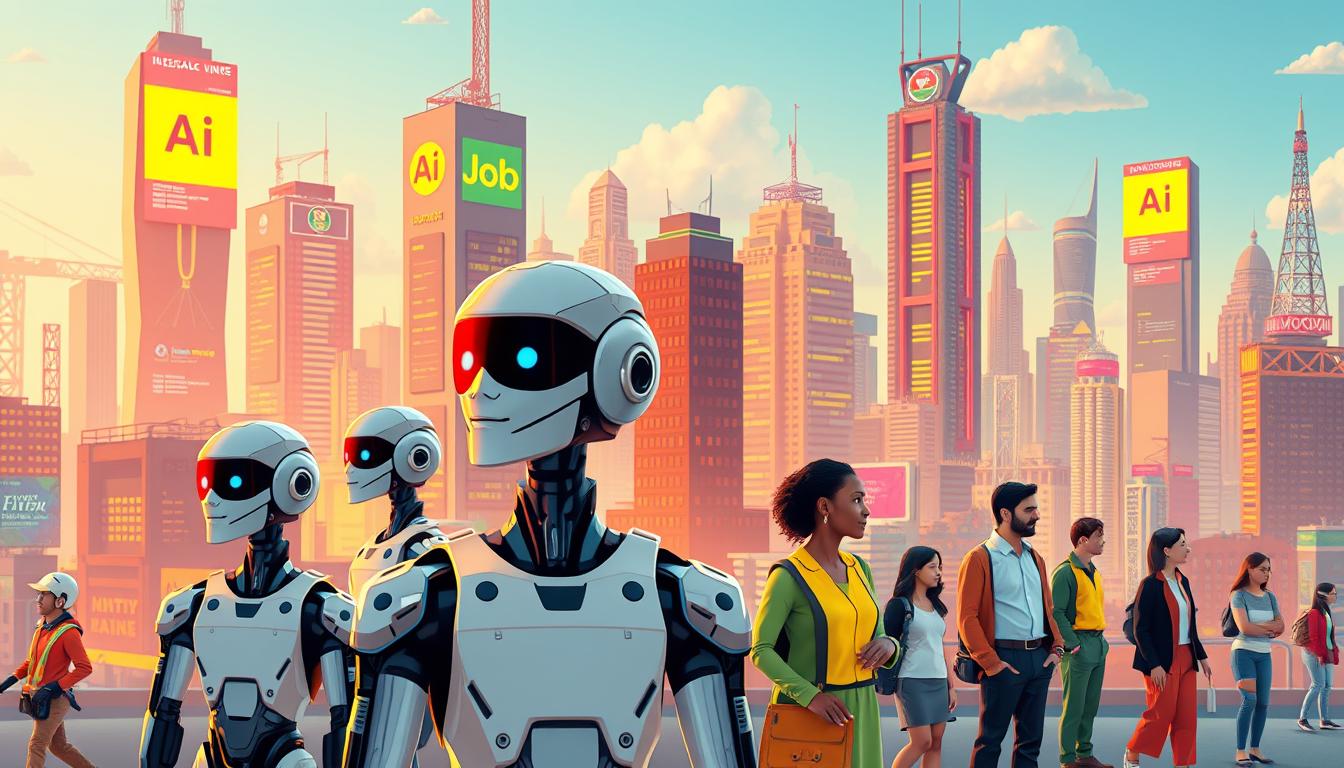
The rise of artificial intelligence (AI) is changing the job market in big ways. It’s creating new jobs and changing old ones. With 52% of companies speeding up their AI plans after the pandemic, AI’s role is growing fast.
AI makes work more efficient and innovative. But, it also raises concerns about job loss. This shows how AI is both a blessing and a challenge for jobs.
AI is making the job market need more skilled workers. Now, there’s a big push for STEM degrees and IT skills. AI is taking over simple tasks, freeing up time for more complex work. This means new jobs are popping up in fields like machine learning and data science.
Key Takeaways
- AI is transforming the employment landscape, creating new opportunities while also posing challenges like job displacement.
- The rapid adoption of AI has accelerated, with 52% of companies accelerating their AI strategies post-pandemic.
- AI is driving a shift towards a more educated workforce, with increased demand for STEM degrees and IT skills.
- AI is automating routine tasks and boosting productivity, while also creating new high-demand roles in AI-related fields.
- Ongoing research and collaborative efforts are essential to address the complex implications of AI on the labor market.
Understanding the AI Revolution in Employment
Artificial intelligence (AI) is changing the job market fast. Technologies like natural language processing and deep learning are shaking up many industries. They create new jobs and automate others. The growth of machine learning and more powerful computers are driving this change.
Current State of AI Integration
Companies are putting more money into AI to improve their work. AI tools can find the best job candidates and predict how well they’ll do. It also helps with onboarding, setting goals, and finding skills gaps.
Key Technological Drivers
Neural networks and natural language processing are key to AI’s impact. They let machines understand and create human-like language. This changes customer service, content creation, and decision-making. Deep learning also helps AI with tasks like recognizing images and making decisions on its own.
Market Transformation Overview
The job market is changing a lot with AI. Some jobs are disappearing, but new ones in AI and data analysis are appearing. There’s a big need for people with STEM skills. Learning and adapting quickly are crucial in this fast-changing AI world.
“The development of full artificial intelligence could spell the end of the human race…It would take off on its own, and re-design itself at an ever-increasing rate. Humans, who are limited by slow biological evolution, couldn’t compete, and would be superseded.”
– Stephen Hawking, renowned physicist
AI’s Role in Job Displacement and Creation
Artificial intelligence (AI) has a big impact on jobs. It can take away jobs but also create new ones. Experts think AI could change 300 million full-time jobs worldwide. Jobs at risk include finance, media, legal, and customer service, where tasks like data analysis and customer chats can be done by AI.
But AI is also making new jobs we never thought of. Now, we have AI prompt engineers, ethicists, and trainers. The need for people with AI skills, especially in data and STEM fields, is growing fast.
- A 2013 University of Oxford study said 47% of US jobs could be automated by AI in 20 years.
- A World Economic Forum report says key skills for AI jobs are analytical thinking, active learning, and creativity.
- AI is leading to new companies and more jobs in data analytics, robotics, and engineering.
As AI keeps changing things, companies need a smart plan to use it. This will help use AI well and fill the skills gap. It’s about making workplaces where humans and machines work together best.

“When AI is used within its capabilities, it can improve a worker’s performance by up to 40% compared to those who do not use it.”
Leading Companies Shaping the AI Workforce
Artificial intelligence (AI) is changing the world, and some companies are leading the way. Tech giants and startups are pushing AI forward. They’re working on expert systems, cognitive computing, and new AI algorithms.
Tech Giants and Their AI Initiatives
The biggest names in tech are leading in AI. Microsoft, Google, Amazon, IBM, and NVIDIA are spending a lot on AI research. They’re hiring experts in data science, software, and hardware.
These giants are using their resources to explore AI’s limits.
Emerging AI-Focused Companies
New companies are also making a mark in AI. DataRobot, Machina Labs, and DataToBiz focus on agile manufacturing and data science. They’re attracting people who want to change the AI world.
Industry-Specific Applications
AI is changing many industries. Accenture, Visa, Deutsche Telekom, Sony, and Reliance Industries are using AI in their work. They’re making things more efficient and personal for customers.
| Company | AI-Focused Initiatives | Glassdoor Rating |
|---|---|---|
| Microsoft | Azure AI, Cognitive Services, Machine Learning Studio | 4.5 stars |
| Google Cloud AI, TensorFlow, Google Assistant | 4.3 stars | |
| Amazon | Amazon Web Services (AWS) AI, Amazon Personalize, Amazon Lex | 3.8 stars |
| IBM | IBM Watson, IBM Cloud Pak for Data, IBM Transerve | 4.0 stars |
| NVIDIA | NVIDIA AI Enterprise, NVIDIA Clara, NVIDIA Metropolis | 3.6 stars |
These companies, along with startups and industry leaders, are shaping the AI workforce. They’re making AI a part of our everyday lives.
Artificial Intelligence Impact on Workplace Productivity
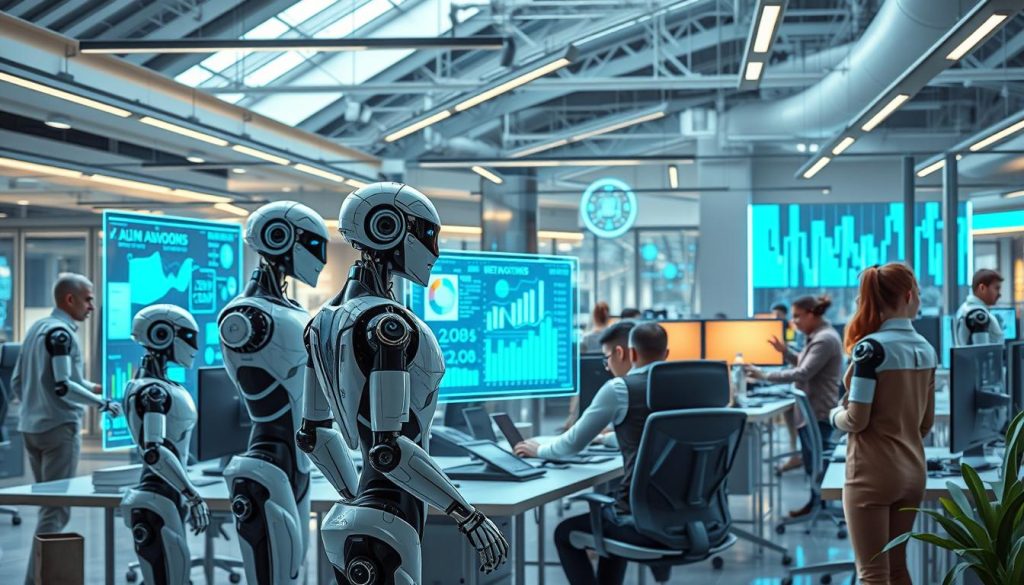
The use of intelligent systems and predictive analytics has greatly improved efficiency and productivity at work. A study with over 700 consultants showed AI can boost worker performance by up to 40%. But, if AI is used wrongly, performance can fall by 19 percentage points on average.
The study found AI helps workers with lower skills the most, increasing their performance by 43%. This means AI can help close the productivity gap and make less-skilled employees more effective.
To get the most out of AI, companies should plan carefully how to use it. They should set clear goals, check their current abilities, and make sure the transition is smooth. This helps avoid skills loss over time.
| Industry | AI Application | Productivity Improvement |
|---|---|---|
| Customer Service | Personalized interactions and instant responses using NLP | Significant reduction in response times and enhanced customer satisfaction |
| Supply Chain Management | Demand forecasting and logistics optimization | Improved inventory management and timely deliveries |
| Human Resources | Automated recruitment and personalized onboarding | Streamlined HR processes and enhanced employee engagement |
| Sales and Marketing | Personalized customer experiences and lead generation | Improved conversion rates and marketing effectiveness |
| Operations | Workflow automation and resource optimization | Reduced human error and enhanced overall productivity |
By smartly using intelligent systems and predictive analytics, companies can reach their full workplace efficiency potential. This leads to big productivity gains in many areas and industries.

“The implementation of AI can provide a short-term productivity boost, but companies must also focus on developing new skill sets to ensure long-term sustainable growth.”
High-Risk Industries and Occupations for Artificial Intelligence
The Turing test is now key as AI grows and changes many fields. Some areas are doing well with AI, but others are facing big changes. AI tools might affect 300 million jobs worldwide, causing big changes in work.
Most Vulnerable Job Sectors
Jobs most at risk from AI include finance, media, legal services, customer service, and transport. Jobs like legal assistants, paralegals, and financial analysts are at risk. AI can quickly analyze data and predict trends.
- 28% of banking jobs in the UK could be automated.
- 25.4% of accountant jobs are at risk of automation.
- Robots might replace up to 20 million manufacturing jobs by 2030.
- AI could replace up to 294,000 truck driving jobs in the US.
Automation Timeline Predictions
The timeline for AI automation varies by field. By 2025, 80% of customer service will use AI. Also, 95% of customer service will be AI-powered. AI is also changing the media world, creating new actors and voice artists.
Economic Implications
The shift to AI could lead to job losses in some areas. But, it could also make work more efficient and create new AI jobs. While job loss fears might be lessened, big changes are still expected. As AI’s data mining gets better, its impact on jobs will grow.
| Industry | Job Automation Risk | Timeline Prediction |
|---|---|---|
| Banking and Finance | 28% of jobs at high risk | N/A |
| Accounting and Bookkeeping | 25.4% of jobs at high risk | N/A |
| Manufacturing | Up to 20 million jobs could be replaced | by 2030 |
| Trucking and Transportation | 294,000 long-distance truck driving jobs at risk | N/A |
| Customer Service | 95% of interactions powered by AI | by 2025 |
| Media and Marketing | AI-created actors and voice artists becoming common | N/A |
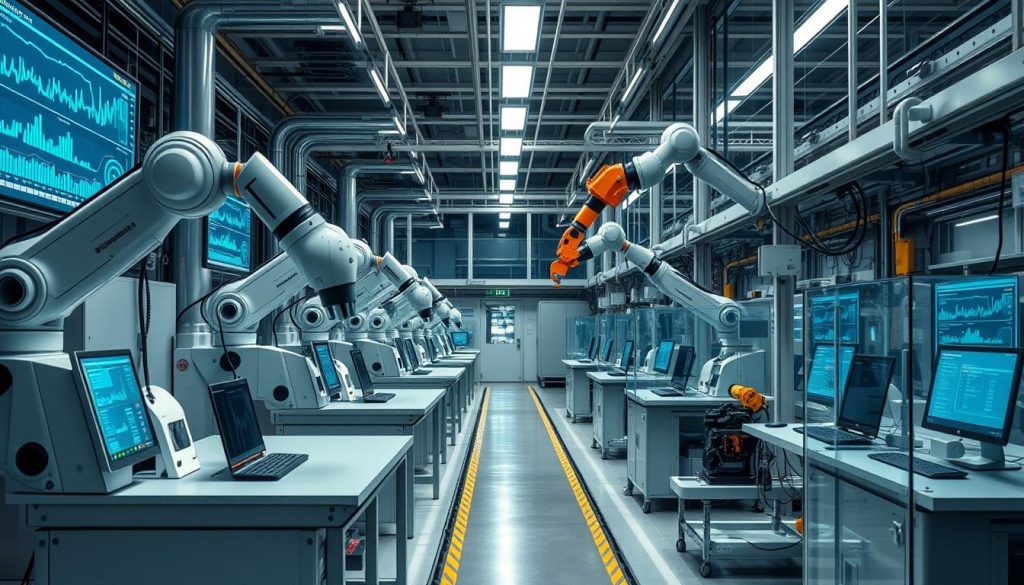
As AI’s Turing test and data mining get better, its effect on jobs will grow fast.
Essential Skills for the Artificial Intelligence Era
Artificial Intelligence (AI) is changing the job market a lot. Workers need special skills to work well with AI. These skills help them use AI’s strengths.
The 2020 Future of Jobs Report from the World Economic Forum lists important skills. These include thinking analytically, learning actively, and solving complex problems. They also mention creativity, leadership, and using technology well.
Skills like empathy and imagination are also key. They help workers work well with AI and keep learning. This way, they can solve big problems and innovate.
| Skill | Importance | Demand Trend |
|---|---|---|
| Analytical Thinking | Critical for leveraging AI algorithms and data-driven insights | Increasing by 22% annually |
| Active Learning | Enables workers to continuously upskill and adapt to technological changes | Projected to rise by 19% in the next decade |
| Complex Problem-Solving | Essential for designing and implementing effective AI-based solutions | Demand expected to grow by 14% by 2030 |
IT pros can learn these skills online. Sites like Coursera, EdX, Udacity, and Fast.ai have courses. They teach machine learning, data science, and deep learning.
Getting a Data Science MicroMasters program is also a good idea. It teaches the tools needed for AI jobs.
By learning these skills, workers can succeed in the AI job market. They open up new chances and help AI grow.
The Human Element: Jobs Resistant to Artificial Intelligence Automation
Artificial intelligence (AI) is changing the job world, but some jobs are safer because they need human-centric skills. These jobs ask for emotional intelligence and creative thinking. They are unlikely to be fully automated soon.
Creative and Emotional Intelligence Roles
Jobs like teaching, nursing, and social work need empathy and creativity. These human-centric roles involve complex interactions and decisions. AI can’t yet replace these skills.
Complex Decision-Making Positions
Jobs that need deep thinking and ethical decisions are hard for AI to take over. Roles like lawyers and management consultants require understanding human behavior. They also need to handle unclear situations.
The human touch in these jobs is still very important. It shows how crucial emotional intelligence and creative problem-solving are in the AI era.
“The role of management consultants, lawyers, and customer-facing sales positions are considered less susceptible to displacement by AI due to the high degree of human interaction and decision-making required in these roles.”
As AI gets better, the need for human-centric skills will grow. This makes these skills more valuable. By focusing on these abilities, people can do well in the changing job market.
AI’s Influence on Recruitment and HR Practices
Artificial intelligence (AI) is changing how companies find, keep, and manage workers. It makes tasks like sorting applications and checking candidates faster. AI can look through resumes in minutes, a job that takes humans weeks.
AI helps understand why workers leave, predict who to hire, and screen candidates fairly. It helps make hiring fair and match candidates with the right job. But, AI can also show biases if its training data is flawed. So, it’s important to watch it closely and fix any problems.
Using AI in hiring is seen as key for businesses to stay ahead. About 35% to 45% of companies use AI in hiring. The AI recruitment market is growing fast, with a 6.17% annual growth rate from 2023 to 2030.
AI can handle lots of applications and find the best matches for jobs. It saves time for recruiters, letting them focus on talking to good candidates. It also helps choose candidates based on their skills, not just looks or background.
Even with AI, human touch is still needed to really get to know candidates. As AI gets better, it will help companies find the right people for their teams. This will help them stay ahead in the job market.
| Key AI in HR Statistics | Percentage |
|---|---|
| Companies that have adopted AI in hiring processes | 35% – 45% |
| Projected compound annual growth rate of the AI recruitment sector (2023-2030) | 6.17% |
| HR leaders exploring or using AI to improve efficiency | 81% |
| HR managers who believe AI helps save costs | 93% |
The use of AI in HR and automated recruitment is changing how we find and keep talent. By using AI, companies can make hiring faster, fairer, and better. This helps them find and keep the best workers for their success.
“Integrating AI into talent acquisition is considered a strategic imperative for business leaders to gain a competitive edge.”
Conclusion
Artificial intelligence (AI) is changing the job market in big ways. People need to be flexible, keep learning, and understand AI well. To stay ahead, it’s key to improve communication skills, build networks, and use AI to work smarter.
AI affects jobs in many ways, creating both new and lost opportunities. While it might replace some jobs, it can also help with research and development. This makes education vital for getting ready for an AI-driven world.
Looking ahead, we must see the good and bad sides of AI. It can make us work better but also raises big questions. By facing these challenges, we can make sure AI helps us grow, not just replace us.